Infinity Green Family Plant Journal
Co-Planting · GSA MDes Case Study
Xiaochen Zhan · Product Design
CASE STUDY · DESIGN INNOVATION & INTERACTION DESIGN
Co-Planting
A family-centred guided tool that uses ‘planting together’ to shift attention away from the illness itself — helping young bipolar disorder patients rebuild connection with their parents.
ROLE
Stakeholder contact · Early research lead
CONTEXT
8-week MDes team project (4 people) · GSA
PARTNER
Moray Wellbeing Hub
OUTPUT
Physical board game / planting handbook












Harnessing the
power of
lived experience
01 · CONTEXT & BRIEF

STAKEHOLDER
Who is Moray Wellbeing Hub
MWH supports people facing mental health difficulties through peer support, a Champion programme, and mental health training. Its core values are Connection, Hope, Identity, Meaning, and Empowerment. I was the only person on the team liaising directly with MWH, interviewing lead contact Chris over email.
Context & Brief
The project came from a real partner, Moray Wellbeing Hub (MWH) — a peer-support mental health organisation in Scotland. The brief they gave us was open and ambiguous: find, through research, where design could genuinely help.
STARTING POINT
A real but blurry starting point: MWH also noted that many Chinese students at GSA may struggle with cultural difference and isolation — but the language barrier makes it hard for the organisation to understand their real needs. Our job was to narrow this open brief into a specific, design-able problem.
Source: Moray Wellbeing Hub
CHIME values, redrawn from moraywellbeinghub.org.uk




















EMPOWER
COMMUNITY
WELLBEING
SELF-MANAGE
7.4%
Depression rate in Forres
(Moray 3.58% · Scotland 5.5%)
76–85%
of people in low- and middle-
income countries go untreated
Stigma
keeps patients from being
treated as equals
DESK RESEARCH · REGIONAL MENTAL HEALTH SNAPSHOT (SELECTED DATA)





END-TO-END
What I owned · Who I worked with
I independently owned: the full MWH relationship (including the expert interview with Chris), the stakeholder desk research, the first half of the engagement-tool research, the first pass of insight analysis, and the BD foundational theory. The rest — the three rounds of testing, the questionnaire, and prototype iteration through to the final outcome — was completed together with my three teammates.
02 · MY ROLE
My Role · Contribution Map
Across this 8-week, 4-person team project, I was the main point of contact between the team and stakeholders, and the driving force behind the early research — I independently owned the MWH relationship and the early research that framed the whole problem, then worked with teammates through testing, prototyping, and the final outcome.
I led
Team collaboration
Partial — verified by teammate
01

Stakeholder &
desk research
02

Engagement tool
research (first half)
03

Tool build + 3
rounds of testing
04

Questionnaire &
interviews
05

BD research &
insights
06

Concept → prototype
→ final outcome
Honesty note (not done by me): the second round of interviews was completed by two other teammates; the BD key-stage and treatment literature was verified by another teammate; the interview with expert Xueyi Liu was conducted by another teammate.






Xiaochen Zhan · Product Design
03 · RESEARCH & NARROWING
Research & Narrowing
We didn't guess. We built our own research tool and used it repeatedly, narrowing an ambiguous brief into a specific, evidence-backed problem.
NARROWING → BD + FAMILY
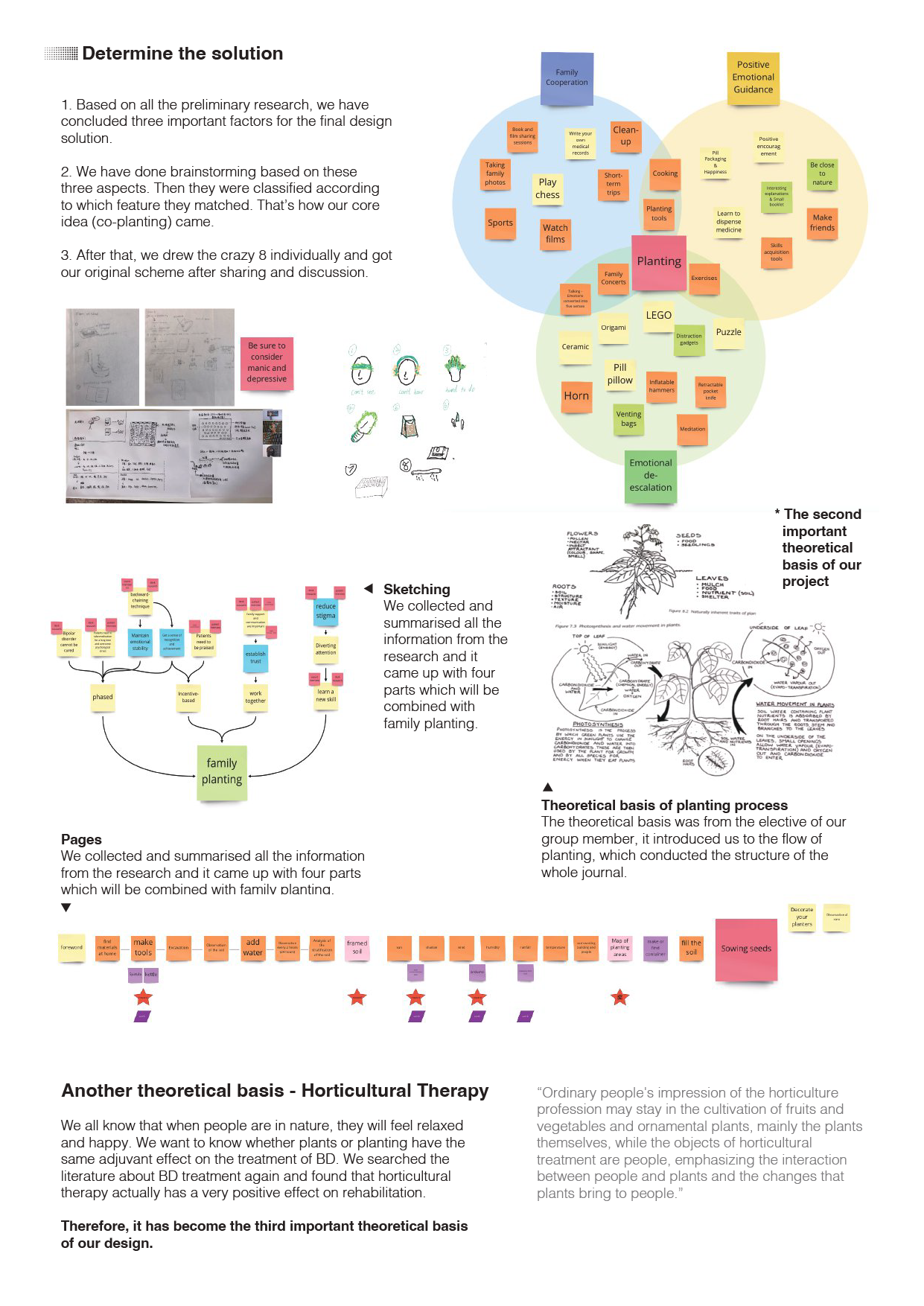
The same cluster of keywords kept surfacing across interviews: communication breakdown, self-denial, negative expression, a crisis of trust with family, immense pressure. ‘Communication breakdown between patients and family’ came up again and again — pointing us toward a more specific direction: bipolar disorder (BD) and family relationships.
QUESTIONNAIRE + INTERVIEWS (STRICT RESEARCH ETHICS)
92 of 126
73% valid response rate, sent within 4 days
92 valid responses

Patients · 41

Family members · 51
Ethics
Followed PGT Ethics Policy 2016
· fully anonymised
RESEARCH TOOL
A self-built engagement tool for icebreaking + data collection
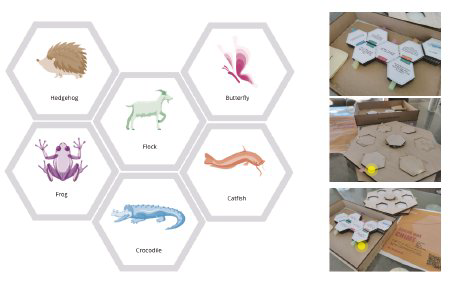
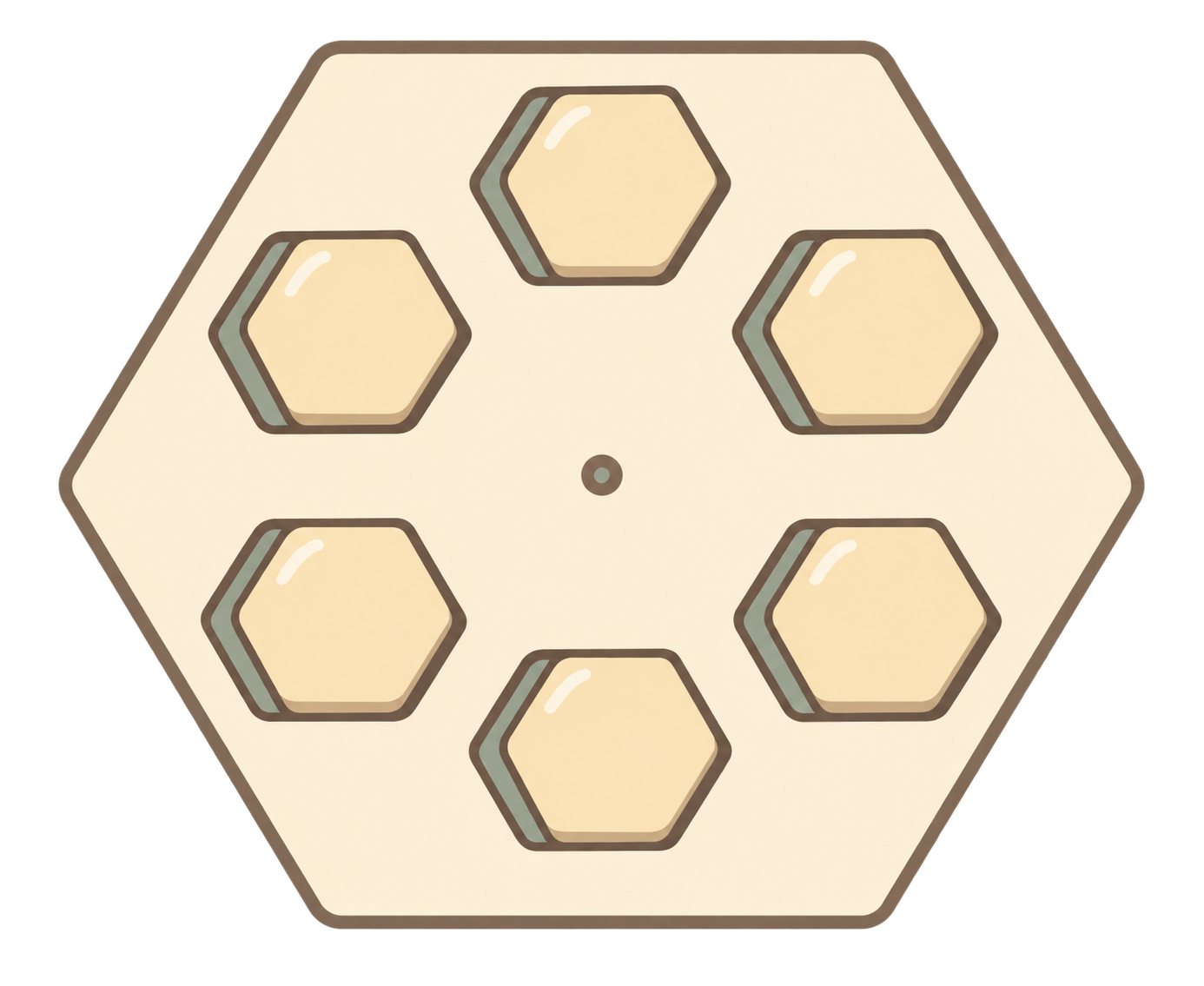
Grounded in communication-method research (active listening, relationship-building, encouraging body language), we built a board-game-style engagement tool to open conversation in an unfamiliar setting while collecting research data at the same time. Questions were adapted from NHS sources for easy benchmarking.
TESTING · ROUND 1
In person · Same language
Best feedback — participants were very willing to share and discuss, and emotion and body language were easy to observe.
TESTING · ROUND 2
Online · Different languages
Willingness to participate, but the language barrier plus being online made some emotions harder to capture.
TESTING · ROUND 3
Online · Same language
High engagement and rich information, but body language and expression were still hard to observe online.
Engagement Tool
Co-Planting · GSA MDes Case Study
Xiaochen Zhan · Product Design
04 · INSIGHTS & HMW
Insights & HMW
The research converged into a clear set of insights, and one key reframing of the problem.
INSIGHT 01
Families ‘don’t know how to be there’
Family members often don't know how to accompany a patient appropriately, or how to encourage them to open up.
INSIGHT 02
Awareness and self-checking are lacking
Public awareness and self-awareness of BD are both low, and BD is often misdiagnosed as depression.
INSIGHT 03
No safe space to talk
Patients and families lack a low-pressure, safe environment in which to communicate naturally.

HOW MIGHT WE · CENTRAL QUESTION
How might we shift the attention of patients and families away from the illness itself, in everyday life?
(An earlier version: how might we improve family relationships for BD patients?) This became the guiding question for everything that followed.
PERSONA
The real lever is the family relationship — not the illness itself
Personas synthesised from two rounds of interviews point to the same place: parents need a shift in mindset, communication is blocked, and both sides want to ‘do something together’ rather than being made to talk about the illness. Patients need encouragement and companionship, not tasks. BD is harder and longer-lasting than depression, and family support matters as much as medical treatment.



Illustration — reframing: shared time together, not the illness







18–21

CBT
+

Family-focused

KEY PERIOD (VERIFIED BY TEAMMATE)
18–21 years old
BD most often first appears between 18 and 21, with up to 60% of people showing symptoms before 21 — so we focused on young patients still living with their parents.
TREATMENT (VERIFIED BY TEAMMATE)
CBT + Family-Focused Therapy
Both cognitive behavioural therapy and family-focused treatment emphasise the role of the family, so we turned our direction toward ‘family relationships + supportive recovery’.
THIRD THEORETICAL PILLAR
Horticultural therapy
‘Interaction with plants and planting’ is shown in the literature to have a positive effect on recovery — this became the third theoretical foundation of the concept.
05 · UNDERSTANDING BD → PRINCIPLES
Understanding BD · Design Principles
To design responsibly, we grounded our concept in how BD actually works, and in what genuinely helps.
WHAT IS BD (MY RESPONSIBILITY)
Like riding a lifelong rollercoaster
BD swings between two poles: mania can bring intense euphoria, high energy and risk-taking, while depression brings deep low mood, helplessness and self-denial. It comes in Type I, Type II and Cyclothymic forms, with a lifetime prevalence of roughly 1–3%, and around 73% of patients see their family relationships affected.
Mood-swing pattern: mania ↔ euthymia ↔ depression

MANIA
EUTHYMIA
DEPRESSION


Mixed state
THREE ELEMENTS → CO-PLANTING
Bringing the three theories together — family support, low-pressure shared activity, and horticultural therapy — the core concept emerged naturally: get a family to ‘plant together’, a shared activity that never talks about the illness, yet naturally builds connection.
Honesty note: I was responsible for the BD foundational theory; literature verification for the key-stage and treatment sections was completed by another teammate.
Illustrative pattern



Co-Planting · GSA MDes Case Study
Xiaochen Zhan · Product Design
06 · DESIGN & ITERATION
Design & Iteration
From principles to a physical product — the concept, expert validation, and repeated prototype iteration.
EXPERT INTERVIEWS
Steadying emotion with ‘small goals + staged rewards’
We interviewed two experts: Xueyi Liu, a psychology master's graduate from York (interviewed by a teammate), and Chris from MWH (interviewed by me). Key advice: family settings carry less pressure than social ones and suit recovery well; set small goals that take time but not much mental effort, with small rewards at each stage to help patients stay stable between mania and depression; reducing stigma matters, and companionship and love matter.
Co-Planting: folding recovery into ‘planting together’
We combined the four strands of our research with ‘family co-planting’ into a planting handbook / board game: a family completes planting tasks together in stages, and the process itself becomes low-pressure companionship. We used Crazy 8s to diverge individually, then merged ideas into our first concept.
PROTOTYPE TESTING FEEDBACK
Iteration takeaways
Staged rewards need to feel relevant, and the final reward should feel distinct; add more planting knowledge and an overview guide; increase family interaction; use more materials that are recyclable and easy to find at home.
RECYCLED MATERIALS RESEARCH
48 people · 46 valid
A questionnaire was used to find out which common household materials ordinary families could recycle and reuse, keeping the experience as eco-friendly as possible.
TASK & IDENTITY CARDS
Turning the process into cards
Task cards (e.g. ‘find a container you’ve used at home, punch holes in it’) + identity cards (tulip = elegance, mushroom = protection, pinecone = resilience...).

Xueyi Liu
MSc Psychology · York

Chris
MWH




07 · FINAL OUTCOME
Final Outcome
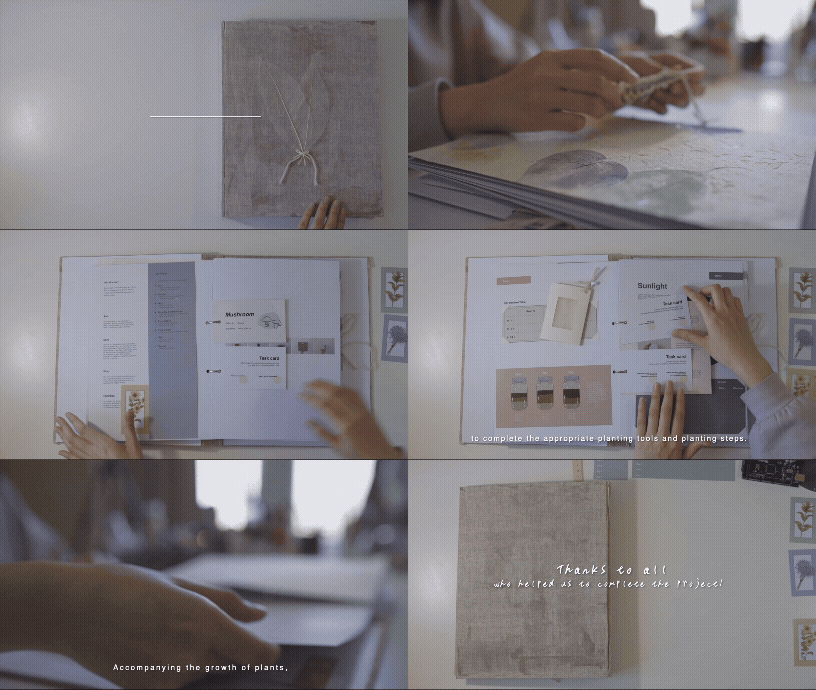
The final product is a family co-planting handbook / board game — putting the principles into a single, tangible object a family can use together.
RESPONDS TO · CENTRAL QUESTION
Plant together, not talk about illness
The whole activity centres on ‘planting together’, naturally shifting attention away from the illness.
RESPONDS TO · EXPERT ADVICE
Small, staged rewards
Complete a small task at each planting stage and receive a small reward, helping keep emotion stable.
RESPONDS TO · THEORETICAL FOUNDATION
Family + horticultural therapy
Grounded in family-focused treatment and horticultural therapy, so companionship and growth happen together.
HONEST POSITIONING
This project's output is a physical tool, not a digital product. What it demonstrates is research-driven thinking, taking an ambiguous brief from 0 to 1, and a systematic approach to a sensitive problem space — complementing my digital UI work.
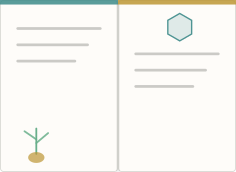
The handbook

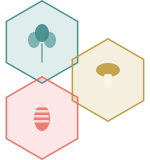
Identity cards
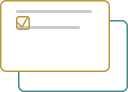
Task cards

Recycled materials


Planting together

08 · REFLECTION
Reflection
A few things this project taught me.
REFLECTION 01
Anchor the original intent
Early on we started treating the engagement tool as ‘the product’ and chased user needs, forgetting the tool’s actual purpose. Lesson: anchor your original intent first, or you’ll drift off course.
REFLECTION 02
Learn to filter information
During desk research I kept wanting more, more complete data — and lost focus instead. Research is only efficient once you filter down to what’s actually relevant.
REFLECTION 03
Ethics with vulnerable users
Most participants were dealing with mental health difficulties, so interview wording had to be handled carefully to avoid causing further harm; we used an ethics form and kept everything anonymous throughout. It also made me reflect: many participants came from social media and were more comfortable speaking up — does the design work equally well for people who aren't?
REFLECTION 04
Teamwork
We resolved disagreements through voting and more careful articulation of ideas. The most important thing on a team isn't realising ‘my’ idea, but respecting everyone's thinking and effort.
FINAL TAKEAWAY
Design exists to serve people. Rather than dazzling the world with forward-looking concepts, I'd rather make ‘ordinary design’ that brings a small, real bit of change and makes things a little easier.